Google Website Translator Gadget

Showing posts with label Obstacles. Show all posts

Saturday, November 24, 2012

The Fatal Flaw in Cape Verde's 2013 Budget

Cape Verde's incumbent government is about to make a fatal mistake in its budget for 2013. At a time when the second round of the global economic crisis is having a serious impact on the local economy, the government has proposed a sharp rise in the VAT (value added tax) on certain basic consumer staples and on certain business sectors. While the VAT on fuel prices will decrease, causing a welcome 20% drop in the price of fuel, taxes on other important drivers of economic growth could result in a major economic calamity in 2013.

Here is the backdrop of the current economic situation:
  • Driven by strong growth in the tourism sector, Cape Verde's economy had been growing at a fairly robust pace of over 7% per year until the global economic recession of late 2008 / early 2009. The pace of growth then slowed to around 5% per year. (UPDATE: Six months after I wrote this article, Fitch rating agency published revised guidance on Cape Verde and said that "Revised GDP data show Cape's Verde's real GDP growth is significantly weaker than previously thought. Under the revised methodology, Fitch's estimate of five-year average real GDP growth up to 2012 is now 2.6%, compared with Fitch's previous calculation of 5.1%.").
  • Cape Verde's finance minister, Cristina Duarte, famously claimed at the time that Cape Verde's economy was somehow immune to the global crisis even though there is a very strong and well known economic correlation between what happens in Europe and what happens in Cape Verde - economically speaking. It was not clear if these statements were politically motivated as the 2010 general election was just around the corner at the time the statements were made. It is difficult to imagine that the minister herself actually believes this.
  • Meanwhile, the 5% growth rate in the overall economy in the face of an even higher pace of growth in the relatively significant tourism sector (which was largely confined to two of Cape Verde's nine islands) suggests that the rest of the economy is experiencing a slowdown (negative growth).
  • In the 2012 State of the Union address, Cape Verde's prime minister, Jose Maria Neves, said that "Cape Verde is on the right track" even as the economic situation in Europe continued to dramatically deteriorate with riots in the streets of Greece and Portugal.
  • In an interview published on 17 October 2012 in the journal A Nação, 267th edition, the prime minister appeared at a complete loss to explain how it was possible that an economy that he claimed to be growing robustly was shedding massive numbers of jobs left and right (the "official" unemployment rate is 12%, but the real rate is substantially higher, and in some islands - like São Vicente - is reputed to exceed 50%).
  • The increase in traffic through Cape Verde's airports - most of which consists of tourists entering and leaving the country - slowed from a double-digit annual pace to a pedestrian 4% in the third quarter of 2012. This big drop is the result of a decline of 6% in domestic traffic along with a reduced pace of growth in international traffic. The decline in domestic traffic is a clear indication that business travel is declining which in turn obviously means that companies and entrepreneurs are doing less domestic business. It is also an obvious indicator that private households with the means to travel inter-island now have less disposable income to continue such travel. These trends clearly indicate an economic decline in the sectors outside of tourism and portend an eventual downturn in the tourism sector if global economic pressures continue unabated, especially in Europe.
It is quite clear from all indicators that Cape Verde's economy is quite fragile at this moment. Yet, the government budget which seeks to raise revenue primarily by increasing taxes, represents a fundamental misunderstanding of economics. The dramatic increase in taxes at a time when the economy is being buffeted by external global economic forces that are not likely to assist with domestic growth will only have one undeniable effect and that is to deliver a death-blow to the economy.

In other words, this economic action will have exactly the opposite effect to that which is desired by the government. It will lead to a reduction in revenues and a major increase in the country's deficit.

Thursday, September 27, 2012

Totally Reengineering TACV, the National Airline

Cape Verde is an island-nation of about half-million residents spread across 10 islands (one of which is uninhabited). The country boasts 4 international airports and a national airline called TACV ("Transportes Aéreos de Cabo Verde"). This airline possesses 5 aircraft. Two are larger jet aircraft (Boeing, Airbus) which make international connections, and three are smaller turbo-prop craft (ATR) which serve the domestic market.

On the international routes, TACV connects the 10-island nation to 18 foreign destinations on three continents...using two aircarft! The three smaller propeller-driven aircraft connect 7 of the 9 islands on the domestic routes (the islands of Santo Antão and Brava do not have the conditions necessary to SAFELY host an airport for planes of the size of the ATRs used in the domestic services). This is quite impressive on paper...large aircraft flying the flag of a small country, domestically and internationally...it is presumably a source of national pride.

That's a really brief summary of TACV and it's services. Now, does anyone see what is terribly wrong with this picture? Perhaps nothing initially appears wrong until you know these additional facts:

  • TACV fails to provide adequate or reliable service domestically...it is often hard or impossible to obtain a reservation for the days and times you need to travel and the prices are often exorbitant;
  • TACV has one of the worst service records you can imagine for both domestic and international routes with overpriced tickets, unreliable website connections, hard-to-buy tickets and cancelled flights among others...rather than a source of pride, it is a source on national and international embarrassment;
  • The company is 100% government owned and loses millions of euros year after year after year.
The picture painted thus has massive flaws. The real question that needs to be asked and answered here is this: can anyone give a rational justification for why a nation with only half-million people really needs an airline that connects internationally to 18 destinations on 3 continents while wasting millions upon million of euros? Serving international destinations for the sake of national pride and honor is a ludicrous notion or a fool's dream.

Sunday, April 22, 2012

Massachusetts MetroSouth Chamber of Commerce visits Cape Verde

Even though Africa is among the newly emerging economic zones around the world, it is not the top destination for American business people or US investors. Instead, the US is late to the party while the likes of China, Europe, Russia and India have already invested hundreds of billions. American sentiments, however, may be changing. Rather than seeing Africa as a single and unique entity in need of donations for starving children, local business groups in the US are starting to understand, through the connections of immigrants from various parts of Africa, that Africa is a multicolored fabric full of economic opportunities.

One example of how this works is highlighted by the visit (April 18-24, 2011)  of a trade mission lead by the Metrosouth Chamber of Commerce, to Cape Verde, West Africa which is considered one of the most stable democracies in sub-Saharan Africa. The business group included bankers, health care professionals, university administrators, and construction companies among others. It is interesting to note that the Chamber primarily represents businesses in the Greater Brockton area where about 25-30% of the population is of Cape Verdean descent.

This is certainly a step in the right direction and fully supported by the author of this blog. The news was covered by the local Cape Verdean media, although the focus was understandably on the Cape Verdean immigrants in the group. There was some interesting commentary by local Cape Verdeans which I make a point of highlighting in this article because some of the comments raised some very relevant issues that are important for US investors to be aware of:

Wednesday, March 21, 2012

The Economic Consequences of Biting the Hand That Feeds You

The island of Brava, which had been isolated from the modern world for decades, was finally connected to the rest of Cape Verde in January 2011 by the Cabo Verde Fast Ferry company. According to public records, the company issued €13.6 million of bonds to acquire two sleek ferries, one of which - the Kriola - began operations in January 2011, connecting Santiago, Fogo and Brava with almost daily, scheduled, fast service; it is a quality of service the likes of which have never been seen before in the islands of the archipelago.

It is the type of transportation operation that has been used for centuries in other countries to stimulate their economies by facilitating the flow of people, goods and labor between locations where these resources exist and where they are needed. That is the essence of a free market economy. But this is a little bit of a conceptual point.

Let's break it down in terms that resonate with the average person. When investors pour millions of euros into a project that allows people to easily and reliably travel to places where they can find work (sell their labor), or sell their products and services, or allows people such as foreign and domestic tourists to visit their location and spend money, this creates business opportunities, jobs and in short - improves lives! It lays the basic foundation for a booming economy in the isolated location. And Brava is no exception.

Yet, all investors who are interested in the Cape Verde market, should be take good note of recent developments when the Cabo Verde Fast Ferry, which operated with stable prices for one year, announced a minor price adjustment in the face of a 20% increase in the price of fuel. The media screamed bloody murder and appeared to have fabricated the extent of the price change. The residents of Brava followed suit and accused the company, which had provided high-quality, modern service, of gouging.

From the information that is publicly available, the island of Brava is about 10 nautical miles from Fogo. A modern fast-ferry consumes about 20 liters of diesel fuel for each mile it travels. And fuel costs about €1 per liter. So it presumably costs around €200 per trip and that is not even counting the company's costs for the crew (jobs for people in Brava) and whatever other costs are involved in operating their company. Assume that this is simply equal to the cost of fuel, so that means the total cost of a trip is around €400.

According to the company's website, the Kriola is said to have about 160 seats. But it's hard to imagine that this boat runs full on each trip between Brava, which has a population of about 6,000 people, and its closest neighboring island, Fogo. If the boat were completely full on every trip, it would carry the entire population of Brava in about 40 days! So let's say the boat is typically one-quarter full on each trip so that there are about 40 residents of Brava on each trip; you would therefore expect the tickets to cost around €10 per person (€400 divided by 40). And in fact, that is about what the tickets appear to cost. Now, since we assumed fuel makes up half the cost of a ticket, with a 20% increase in the cost of fuel, the new price of a ticket should cost about €11, for an increase of around 10%.

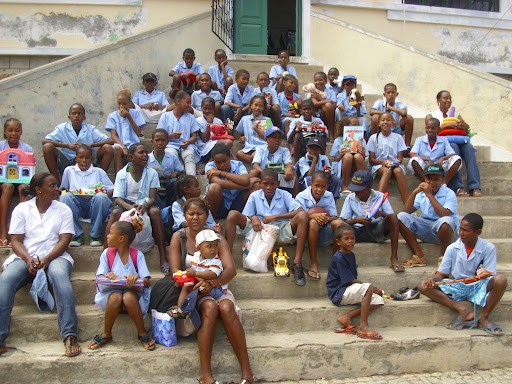
CVFF gives toys to the children of Brava
In the news reports, that is exactly what the company claims it did. But you would have thought that the tickets were instead €100 each, given the outcry and the exaggerated media reports (or what most people would call outright lies). So I would simply ask this ... when investors provide millions of euros to create a company which provides services that can alter the economic landscape of a country, but are criticized for rational, economic actions that are normal in a free market economy, as if they were criminals, why should capital flow to that economy?

The people of Brava are perhaps a microcosm for what may ail Cape Verde in general when it comes to attracting investments and modernizing its economy. It appears that neither the media nor the people who benefit most from the use of that capital, understand or appreciate what is in fact being done for them. They appear unable to place a value on those services. They act as if they are entitled to this capital! But in the real world, it is not that easy. When companies who are doing the right thing are viciously attacked by the media and by the very public which is being fed by that capital, it sends a strong message to those who hold capital for investment and economic growth that they are much better off taking their businesses elsewhere in the world.

Foreign investors are advised to do their homework not just about the needs in Cape Verde's markets, but more importantly, these investors must study the attitudes of Cape Verde's consumers who seem to be eager to bite the very hands that feed them. This is definitely not a good recipe for economic progress.

Wednesday, September 7, 2011

TACV - Cape Verde's National Embarrassment

I've had it up to here with TACV, Cape Verde's national airline! A national airline carries the country's badge into international destinations and is normally a source of pride for the citizens of the country. In the case of TACV, "Transportes Aéreos de Cabo Verde", it is instead a national disgrace for Cape Verde.

Now don't get me wrong. No airline is perfect. But the question here is this: can an airline be any worse?

I happen to be a travel warrior myself, chalking up almost one million miles of international travel and domestic travel in the USA. I have personally never experienced anything worse. Here is a brief sample of the service issues and horror stories with TACV:

Economics 101 for Cape Verde

I've been immersed in on-the-ground research and activities in Cape Verde which have provided me with a very close-up view of the consumer, business and government practices in Cape Verde that have major implications for Cape Verde's current and future economy.

I've summarized my findings into three key lessons in Economics that Cape Verde would do well to learn:
  1. The private sector and middle class grow economies, not governments;
  2. Customer service and ease of doing business matter a lot;
  3. Lowest price does not mean you will have the lowest costs in the long run;
Below, I've expanded on each of these areas.

Thursday, July 14, 2011

The ease of doing business in Cape Verde

You're probably familiar with the philosophy of the "ease of doing business."

Most investors, entrepreneurs and business people have come up through the school of hard knocks. You've either been guilty of offenses against that philosophy and learned the hard way that not being easy to do business with almost guarantees failure, or you may have been on the receiving end of a clueless business you've dealt with that resulted in a frustrating experience. You probably showed your displeasure by not ever doing business with that company and moreover, you likely warned all of your business associates about the clueless company. The lesson learned from this by every successful business owner is that the easier you are to do business with, the more business you will do ... and vice versa.

It's one of the keys to business growth. And so it is with national economies. The easier it is to do business in a given country, the greater the amount of economic activity. It's pretty simple when you think about it. Anything that gets in the way of transacting business retards growth.

The ease of doing business is the oil that greases the engine of a national economy. A well-oiled engine not only runs faster, it also runs more cost effectively. It's that simple.

The truth about investing in Cape Verde is that the country is still in the midst of the learning process. I have personally experienced the bureaucracy and inefficiency. Here is an interesting anecdote about doing business in Cape Verde. It is the story of a government bureaucrat who had been in his particular role for over two decades. The sum of his accomplishments over his term was exactly zero - which is being quite generous in the assessment. He presided over endless disasters, was accountable to no-one and built himself a little fiefdom. Everyone wondered why no problems were being solved within this area. Yet, he was allowed to persist in his post.

The challenge is this - people in government preside over portfolios that directly affect the economic lives of hundreds of thousands of the citizens they serve. When the citizenry are relatively poor, the bureaucrats are viewed as lords or even gods - such is the power vested in them by the people. And the appointees appear to believe that they are in fact lords over the portfolios entrusted to them. To bring the discussion full circle back to the "ease of doing business", these "lords" see themselves as being in control of your business destiny. They prove their deity to you by becoming obstacles in the way of economic freedom: deliberate obfuscation, unnecessary or senseless rules, chains of approvals, stamps, signatures, required formats and formalities, control of the length of time that it takes to accomplish things - these are all part of the tools of the trade of bureaucracy. So they are in fact lords and gods of economic gridlock because that is exactly what happens under their domain.


Saturday, June 18, 2011

Mosteiros: a microcosm of the economic challenges facing Cape Verde

In Mosteiros, on the island of Fogo, the local businesses are experiencing a drop in business activity including fewer hotel stays, fewer restaurant visits, less shopping, and so on. Business owners are reporting that "they have never seen such slow sales". It is quite ironic that while Mosteiros is experiencing a drop, the economic activity continues to accelerate on the islands of Sal and Boa Vista. After all, Mosteiros is a quaint and beautiful town and is second only to São Filipe in terms of the population on Fogo. The restaurant at Chão de Café is one of my absolute favorites, with the freshest of organically grown vegetables and a fresh catch of fish – it is hard to beat for a delicious, mouth-watering meal.

As local newspaper, Asemana, reported:
Leonor Rodrigues, the owner of the Christine & Irmãos bed and breakfast, reveals that only two guests have stayed at their establishment in the past two months. Rodrigues calls the situation “worrisome.” “We’ve been open more than 20 years and we’ve never been through a drop in demand like this,” she claims.
So what might explain this mysterious state of affairs where a town that obviously has much to offer short term visitors is suddenly seeing a dramatic reduction in economic activity while the overall economy grows?

It’s a great opportunity for a lesson in economics. I believe it is due to the increasingly distorted economic imbalances between the “haves” and “have-nots” in Cape Verde. I’m not referring to private individuals in this case, but to the actual key population centers on the various islands. As Sal and Boa Vista drive the national economy ever higher through tourism growth, it has a perverse destabilizing effect: the population centers that benefit most from the economic growth become relatively more attractive than those that do not. The irony is that while the overall national economy grows, the “have-nots”, like Mosteiros, get left further and further behind. The root cause is the lack of economic linkages and Mosteiros is a classic example.

Saturday, June 4, 2011

The economic and social impact of price controls in Cape Verde

Cape Verde has historically had a very high rate of poverty but has managed to significantly alleviate poverty levels through effective governance and policies for economic growth. Poverty has by no means been completely eliminated - about 30% of the population lives at or below the poverty line.

Protection of the poor has been one element of the economic philosophy that has been especially effective up to the current times. The Cape Verde government established ARE or Agência de Regulação Económica (Economic Regulatory Agency) to control prices for certain products and public utilities such as electricity, water, oil products and transportation.

For example, in the case of water, ARE set the following maximum prices on April 12, 2011 (all prices are in local currency of escudos per cubic meter per month and before value added taxes):

Wednesday, April 27, 2011

The obstacles to Import-Export business investments in Cape Verde

The economy of Cape Verde suffers from a poor natural resource base and lack of water which hampers agriculture. Naturally, the economy is thus service oriented with commerce, transportation and tourism accounting for 75% of GDP.

The Cape Verde government has done a stellar job in managing the economy, and has made the right calls by encouraging significant investments in Tourism for example. But given the constraints, most products must be imported since they are not manufactured there.

So a natural question is whether and how investments in Import and Export can be encouraged. Either activity increases jobs and improves the quality of life. Let's take imports for example. If I import goods into Cape Verde, I would have to employ people to move the goods and generate sales in the market. I also increase the available choices and competition for goods of this type. So everyone wins. But if the importer cannot make a profit, then no investments will be made in this type of business.