Google Website Translator Gadget

Showing posts with label Corporations. Show all posts

Wednesday, March 21, 2012

The Economic Consequences of Biting the Hand That Feeds You

The island of Brava, which had been isolated from the modern world for decades, was finally connected to the rest of Cape Verde in January 2011 by the Cabo Verde Fast Ferry company. According to public records, the company issued €13.6 million of bonds to acquire two sleek ferries, one of which - the Kriola - began operations in January 2011, connecting Santiago, Fogo and Brava with almost daily, scheduled, fast service; it is a quality of service the likes of which have never been seen before in the islands of the archipelago.

It is the type of transportation operation that has been used for centuries in other countries to stimulate their economies by facilitating the flow of people, goods and labor between locations where these resources exist and where they are needed. That is the essence of a free market economy. But this is a little bit of a conceptual point.

Let's break it down in terms that resonate with the average person. When investors pour millions of euros into a project that allows people to easily and reliably travel to places where they can find work (sell their labor), or sell their products and services, or allows people such as foreign and domestic tourists to visit their location and spend money, this creates business opportunities, jobs and in short - improves lives! It lays the basic foundation for a booming economy in the isolated location. And Brava is no exception.

Yet, all investors who are interested in the Cape Verde market, should be take good note of recent developments when the Cabo Verde Fast Ferry, which operated with stable prices for one year, announced a minor price adjustment in the face of a 20% increase in the price of fuel. The media screamed bloody murder and appeared to have fabricated the extent of the price change. The residents of Brava followed suit and accused the company, which had provided high-quality, modern service, of gouging.

From the information that is publicly available, the island of Brava is about 10 nautical miles from Fogo. A modern fast-ferry consumes about 20 liters of diesel fuel for each mile it travels. And fuel costs about €1 per liter. So it presumably costs around €200 per trip and that is not even counting the company's costs for the crew (jobs for people in Brava) and whatever other costs are involved in operating their company. Assume that this is simply equal to the cost of fuel, so that means the total cost of a trip is around €400.

According to the company's website, the Kriola is said to have about 160 seats. But it's hard to imagine that this boat runs full on each trip between Brava, which has a population of about 6,000 people, and its closest neighboring island, Fogo. If the boat were completely full on every trip, it would carry the entire population of Brava in about 40 days! So let's say the boat is typically one-quarter full on each trip so that there are about 40 residents of Brava on each trip; you would therefore expect the tickets to cost around €10 per person (€400 divided by 40). And in fact, that is about what the tickets appear to cost. Now, since we assumed fuel makes up half the cost of a ticket, with a 20% increase in the cost of fuel, the new price of a ticket should cost about €11, for an increase of around 10%.
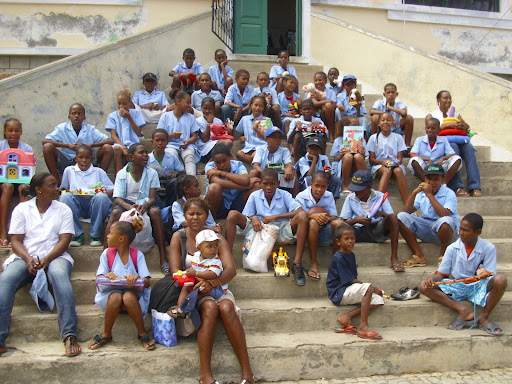
CVFF gives toys to the children of Brava
In the news reports, that is exactly what the company claims it did. But you would have thought that the tickets were instead €100 each, given the outcry and the exaggerated media reports (or what most people would call outright lies). So I would simply ask this ... when investors provide millions of euros to create a company which provides services that can alter the economic landscape of a country, but are criticized for rational, economic actions that are normal in a free market economy, as if they were criminals, why should capital flow to that economy?

The people of Brava are perhaps a microcosm for what may ail Cape Verde in general when it comes to attracting investments and modernizing its economy. It appears that neither the media nor the people who benefit most from the use of that capital, understand or appreciate what is in fact being done for them. They appear unable to place a value on those services. They act as if they are entitled to this capital! But in the real world, it is not that easy. When companies who are doing the right thing are viciously attacked by the media and by the very public which is being fed by that capital, it sends a strong message to those who hold capital for investment and economic growth that they are much better off taking their businesses elsewhere in the world.

Foreign investors are advised to do their homework not just about the needs in Cape Verde's markets, but more importantly, these investors must study the attitudes of Cape Verde's consumers who seem to be eager to bite the very hands that feed them. This is definitely not a good recipe for economic progress.

Thursday, April 28, 2011

How important are small businesses to the U.S. economy?

Small firms:
  • Represent 99.7 percent of all employer firms.
  • Employ just over half of all private sector employees.
  • Pay 44 percent of total U.S. private payroll.
  • Have generated 64 percent of net new jobs over the past 15 years.
  • Create more than half of the nonfarm private gross domestic product (GDP).
  • Hire 40 percent of high tech workers (such as scientists, engineers, and computer programmers).
  • Are 52 percent home-based and 2 percent franchises.
  • Made up 97.3 percent of all identified exporters and produced 30.2 percent of the known export value in FY 2007.
  • Produce 13 times more patents per employee than large patenting firms; these patents are twice as likely as large firm patents to be among the one percent most cited.

Source: US Small Business Administration

The following link may be helpful in obtaining more detailed research data:

Creative financing strategies to attract US small business investors

In an earlier post, I noted that creative financing strategies could be used to attract tens or hundreds of millions of US investment dollars into Cape Verde. The source of these funds would be the trillions of dollars in US money market funds.

Here is how it would all work:


Wednesday, April 27, 2011

Why US small business is the ideal target for investments in Cape Verde

There are two types of corporations in the US, for-profit and non-profits or charities. We can put the charities aside for now with the caveat that there are several charities who direct funds toward African countries, but such investments for charitable purposes are not the type on investment opportunities of which we are speaking.

We thus focus strictly on for-profit corporations when we use the term, "corporation." And again, in the US, corporations are generally divided into two types - large corporations and small businesses.

Examples of large US corporations are Citibank, GM, MetLife, Mobil Oil and Apple. The use of the word "large" when describing these corporations is actually quite deceptive. Large corporations in the US are not simply large, they are enormous. They have extremely deep pockets and huge investment war-chests to use. But, with all due respect, Cape Verde is just too small to attract any attention from these types of corporations. When these companies invest, they do so to the tune of billions of dollar. This would be an overwhelming event for Cape Verde except if it were some type of strategic investment - for example if oil were discovered off the cost of Cape Verde.

So this leaves us with the US small business. Let's look at what this term actually means. Here too, the word "small" is also extremely misleading. Most people who hear the expression "small business" would probably assume that the business in question employs a handful of people. However, small businesses in the US are actually the primary engine of growth and employment in the US economy. These businesses may employ hundreds or even thousands of workers, and may command tens or even hundreds of millions of dollars of revenue.